
INTRODUCTION
The Carbon Border Adjustment Mechanism (CBAM) is governed by Regulation (EU) 2023/956 and Commission Implementing Regulation (EU) 2025/2083. CBAM addresses carbon leakage, which happens when companies shift their production to non-EU countries with less strict emission regulations.
CBAM aims to level the playing field by assigning a fair price to the carbon emitted during the production of certain carbon intensive goods imported into the EU, aligning it with the carbon cost faced by EU industries under the Emissions Trading System (ETS). This mechanism encourages cleaner industrial production worldwide and complements the gradual phase out of free allowances under the ETS, thereby supporting the decarbonisation of EU industry.
The Climate Action Authority is the National Competent Authority in Malta for this Regulation.
CBAM started its transitional phase on 1 October 2023 and ended on 31 December 2025, importers were required to report the embedded emissions related to the CBAM goods.
The definitive phase began on 1 January 2026. A single 50 tonne threshold per calendar year now applies (Article 2(3a) Commission Implementing Regulation (EU) 2025/2083). This de minimis rule covers all CBAM goods except hydrogen and electricity.
STAKEHOLDERS AND GOODS AFFECTED BY CBAM
CBAM applies to importers bringing 50 tonnes or more per year of the following goods categories from non‑EU countries:
- Cement
- Iron and steel
- Aluminium
- Fertiliser
- Hydrogen
- Electricity
CBAM goods are listed in Annex I to the CBAM Regulation.
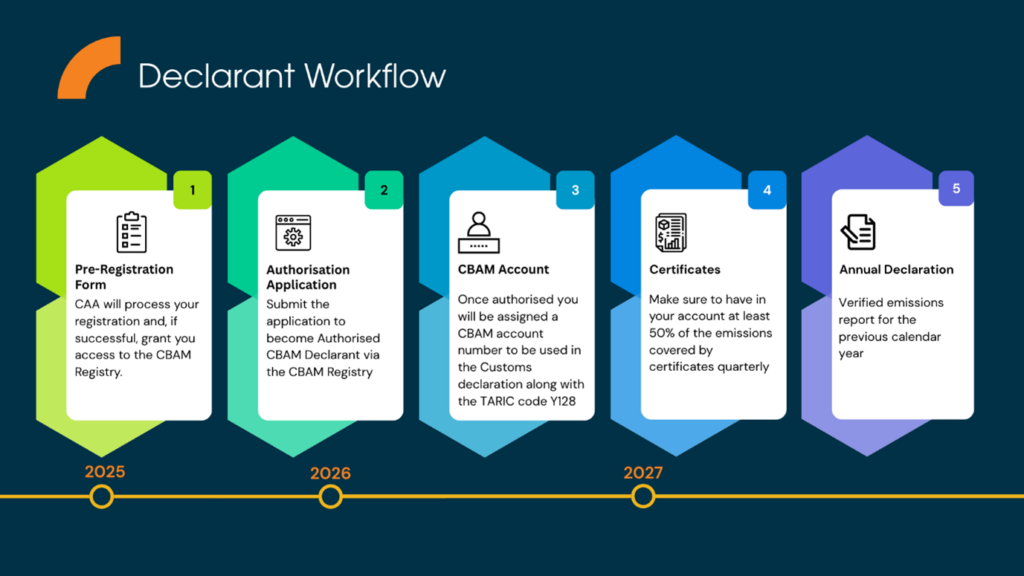
Importers who expect to reach or exceed 50 tonnes of CBAM goods imported from non‑EU countries for release for free circulation in a calendar year must apply to become an authorised CBAM declarant before continuing to import these goods.
Importers must apply before reaching the cumulative 50‑tonnes limit to ensure smooth customs clearance, avoid delays and penalties.
Importers who submitted their application by 31 March 2026 may continue importing while their authorisation is being processed.
You can check if a CN Code falls under the scope of CBAM obligations by entering the CN Code and country of origin in the TARIC database.
HOW TO APPLY
The application for Authorised CBAM Declarant status must be submitted by:
- Importers established in Malta who import goods covered by the CBAM.
- Indirect Customs Representatives (ICRs) appointed by importers established in Malta, under Article 18 of Regulation (EU) No 952/2013 (Union Customs Code), provided they assume CBAM obligations on behalf of the importer.
- ICRs appointed by importers established outside Malta, under the same Article 18. In these cases, appointing an ICR is mandatory, and the ICR automatically assumes all CBAM obligations that would otherwise fall on the importer.
The application process to become an Authorised CBAM Declarant is free of charge.
Steps to apply
- Fill in the CAA_CBAM Pre‑Registration Form (signing with Adobe Digital e-Signature).
- Send the completed form to [email protected].
- Wait for confirmation from the Climate Action Authority (CAA) by email. This confirmation activates your access to the CBAM Registry Declarant Portal.
After receiving confirmation, access the CBAM Registry Declarant Portal and submit your application for Authorised CBAM Declarant status. You can find further guidance below.
Importers who do not expect to exceed the 50‑tonne threshold of CBAM goods in 2026 are not required to apply for Authorised CBAM Declarant status.
However, importers must closely monitor their import volumes and apply for authorisation in good time if they anticipate reaching or exceeding the threshold. Importers who exceed 50 tonnes without authorisation will be subject to CBAM import restrictions under Article 4 and related provisions of the CBAM Regulation, as well as applicable penalties.
Please note that the legislation allows 120 days for the National Competent Authority (NCA) to assess and decide on each application. Importers should therefore factor this period into their planning if they expect to import more than 50 tonnes.
IMPORTANT: if you (as an importer or indirect customs representative) apply for authorisation but do not exceed the 50‑tonne threshold during the calendar year, no financial or reporting obligations will apply. The obligations to report emissions and surrender the corresponding CBAM certificates will only take effect once the threshold is reached, at which point all CBAM goods imported become reportable.
KEY DATES FOR 2026 IMPORTS
Obligation | Deadline | Provisional rule |
Purchase of CBAM certificates | From Feb 2027 | Sale starts later to give visibility |
First annual CBAM declaration for 2026 | Sep 30, 2027 | FIRST declaration ever |
Surrender of certificates (for 2026 emissions) | Sep 30, 2027 | Same date as declaration |
Request repurchase of leftover 2026 certificates | Oct 31, 2027 | 2026 certificates can ONLY be repurchased in 2027 |
Cancellation of certificates | Nov 1, 2027 | 2026 certificates cancelled if unused |
KEY DATES FOR 2027 IMPORTS
Obligation | Deadline | Comments |
Quarterly 50% coverage requirement | 31 Mar, 30 Jun, 30 Sep, 31 Dec 2027 | Applies from 2027 onward |
Annual CBAM declaration for 2027 | Sep 30, 2028 | End of Import Year +9 months |
Surrender of certificates for 2027 | Sep 30, 2028 | Same as declaration |
Repurchase of leftover 2027 certificates | Oct 31, 2028 | Normal yearly timeline |
Cancellation of certificates | Nov 1, 2029 | Normal cancellation rule: “year before previous year” |


