


Carbon Border Adjustment Mechanism Frequently Asked Questions
What’s the aim of the CBAM?
The aim is for the European Union to achieve net zero emissions by 2050 and for the EU to bear the responsibility of the emissions it is emitting in third countries.
AUTHORISATION & RESPONSIBILITIES
CBAM applies to individuals and companies that import 50 tonnes or more per year of certain goods from outside the EU into the EU. For the complete list of CN codes that fall in scope of CBAM, kindly consult the Annex I at the end of this page: https://climateaction.gov.mt/cbam/
If you are subject to the CBAM obligations, you are required to become an authorised CBAM Declarant to be compliant and prevent incurring any penalties.
To register for CBAM, download the pre-registration form that best reflects your business (either companies or for individual persons) which you can find at https://climateaction.gov.mt/cbam/
Fill the form and send it to [email protected] with the required documentation. Once your application is processed, you will be given access to the CBAM portal where you will be able to launch your application.
The pre-registration form must be digitally signed by Adobe Acrobat (desktop version). You may find a guidance document here: https://climateaction.gov.mt/cbam/
Fill the form and send it to [email protected] with the required documentation. Once your application is processed, you will be given access to the CBAM portal where you will be able to launch your application.
The CBAM regulation applies only to certain goods made from Iron & Steel, Aluminium, Cement, Fertiliser, Hydrogen and Cement, originating from non-EU countries (except for Iceland, Liechtenstein, Norway, Switzerland, Büsingen, Heligoland, Livigno, Ceuta, Melilla).
No, this Regulation applies only to CBAM goods originating in third countries and imported into the customs territory of the Union. CBAM goods produced in the EU countries are not subject to CBAM reporting obligations.
However, if relevant precursors of CBAM goods produced in the EU are used to produce CBAM goods in third countries, the embedded emissions of those precursors also must be accounted for in the determination of the embedded emissions.
Yes, it is strongly recommended that you still apply. There are no associated fees with the application process, and it ensures that you remain compliant should the threshold be exceeded unexpectedly.
No CBAM obligations apply in such cases.
Exceeding the 50-tonne threshold without authorisation may result in your imports being blocked at Customs. Additionally, penalties may apply as per EU and National law.
Please note that the CBAM regulation does not apply to raw materials only. There are 6 categories of goods that fall within scope of CBAM. For the full list of CBAM goods, please refer to the Commodity Code List to check whether the goods you import fall in the CBAM scope (See Annex I at the end of this page https://climateaction.gov.mt/cbam/ ).
Usually, the application is reviewed within days. However, the CAA may require amendments to your application if something is missing, incorrect or requires clarification.
If you plan to act as a CBAM declarant in other Member States, then a consultation with these Member States is required. This consultation may take some time.
If you have been operating for less than 2 years, a bank guarantee is required. You would thus need sufficient time to provide this bank guarantee.
Taking into consideration the above, it is strongly suggested to launch your application well before planning to exceed the threshold to ensure that the process runs smoothly.
A Tax Compliance Certificate issued in the last 3 months must be submitted. For the certificate to be acceptable, there must be no pending returns or liabilities. In case that there are pending liabilities, these must be covered by a formal agreement that is being honoured.
When only the first four numbers are indicated it means that any good having the CN number starting with those numbers is included in the CBAM regulation and, hence, need to be reported unless they fall into the clearly mentioned exceptions.
It is likely that, with time, more goods will be added to the list.
The mass-based threshold is subject to annual review to ensure that 99% of EU embedded emissions from CBAM-covered goods are covered. Therefore, it may change according to the review.
No, ‘Electricity’ refers to the actual import of electricity from power plants or alternative sources. Malta imports its electricity from Italy (EU); hence no one is expected to apply as electricity importer for the time being.
CBAM Authorisation should be obtained in the Member State where the reporting declarant is established. If you are the one submitting report, then you should register in Malta through the CAA. If the customs representative is responsible for CBAM reporting, then he/she should register in his/her country of establishment. If you will be acting as a CBAM declarant in other Member States, this should be specified in your application.
The CBAM authorisation and the CBAM reporting must be submitted to the National Competent Authority of the Country where the declarant is established, in this case during the authorisation process, the Malta NCA will need to request a consultation to the Member State where imports arrive.
Yes, this is possible.
If you would like to represent multiple companies owned by the same group/owner, and you are employed with one of the companies, you can register as an Indirect Customs Representative, using the EORI of one of the companies.
A Customs Representative may choose whether to take on CBAM responsibilities. However, only a formally appointed Customs Representative can act in this capacity, meaning a third party cannot assume CBAM responsibilities unless they are also appointed as the Customs Representative for the economic operator.
If you would like to represent multiple companies but you are employed with an external company who would like to provide the service to several other companies, then you will need to register as an Indirect Customs Representative, using your own EORI or the one of the company you work with.
It is important to ensure that the Customs Representative agrees to act on the Economic Operator’s behalf for at least a full CBAM cycle to avoid sudden dropouts.
When an indirect customs representative handles CBAM requirements for an importer, they become responsible for complying with the CBAM rules for those imported goods, just as the importer would be.
Please contact us at [email protected] so that we can update the records.
Contact us at [email protected] with your request to delete your account, and we will initiate the procedure for the account deletion. Kindly note that the retention of personal data will be treated in line with our GDPR procedures.
LOGIN ISSUES
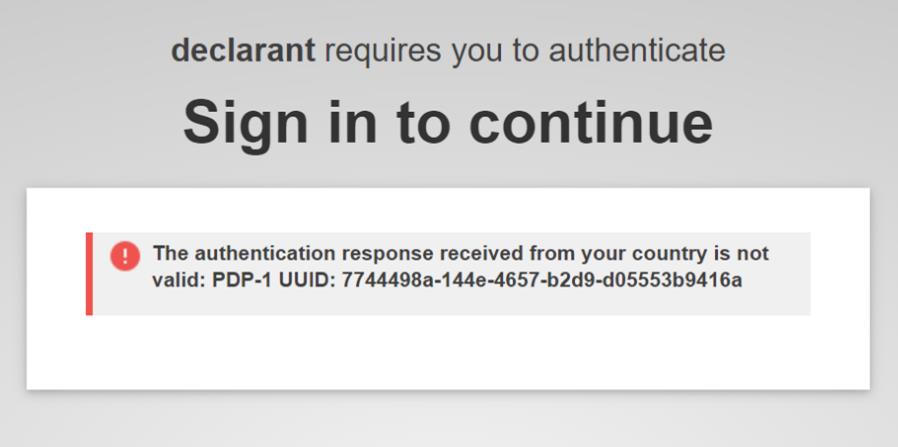
Please make sure that you are trying to access the right portal: https://cbam.ec.europa.eu/authorised-declarant

Also, make sure you select the proper ‘Type of actor’, which can be either ‘Economic operator’ or ‘Customs representative’.
In the ID field enter the EORI (VAT) number with no spaces nor dashes. Select ‘I am acting on behalf of:’ ‘Myself’ and tick the last box.
Finally, click ‘Submit’.
Sometimes the system memorises the wrong access information provided and, as a result will deny your access. In this case, clean the browser cache and restart the browser. If this doesn’t work, try restarting the computer.
Moreover, the website may also not respond correctly due to maintenance and/or update.
If the issue persists, please contact us at [email protected]
REPORTING
The annual CBAM declaration for 2026 must be submitted by the 30th of September 2027. Please find more information about obligations and deadlines here: https://climateaction.gov.mt/cbam/
Emissions related to your imports may be determined by Actual Data or Default Values.
- Actual Data: The supplier provides actual embedded emissions related to your imports based on the CBAM methodology. Such emissions need to be verified by an accredited verifier. The first verifiers are expected to obtain accreditation in September 2026. It is recommended that you engage with a verifier as soon as possible.
- Default Values: It is expected that not all importers will have verified actual data available. Thus, the Commissions has published Country-specific Default Values for each good. It is very likely that the use of Default Values will lead to an increased CBAM cost.
From 2027 onwards, the Commission will calculate and publish weekly prices. The price of CBAM certificates reflects the average price of EU Emissions Trading System (EU ETS) allowances.
For 2026 only, the Commission will calculate and publish Quarterly prices. These prices may be found here: https://taxation-customs.ec.europa.eu/carbon-border-adjustment-mechanism/price-cbam-certificates_en#quarterly-prices-in-2026
LEGAL BASIS
The principal legal basis for CBAM is Regulation (EU) 2023/956 establishing a carbon border adjustment mechanism, together with the delegated and implementing acts adopted under that Regulation. In Malta, the national provisions necessary for its implementation, particularly the mechanism for the imposition and enforcement of administrative penalties, are set out in the Carbon Border Adjustment Mechanism Implementation Regulations, 2026 (S.L. 643.07).
The mechanism for the imposition and enforcement of administrative penalties, is set out in the Carbon Border Adjustment Mechanism Implementation Regulations, 2026 (S.L. 643.07).
