


EU Emissions Trading System for Shipping
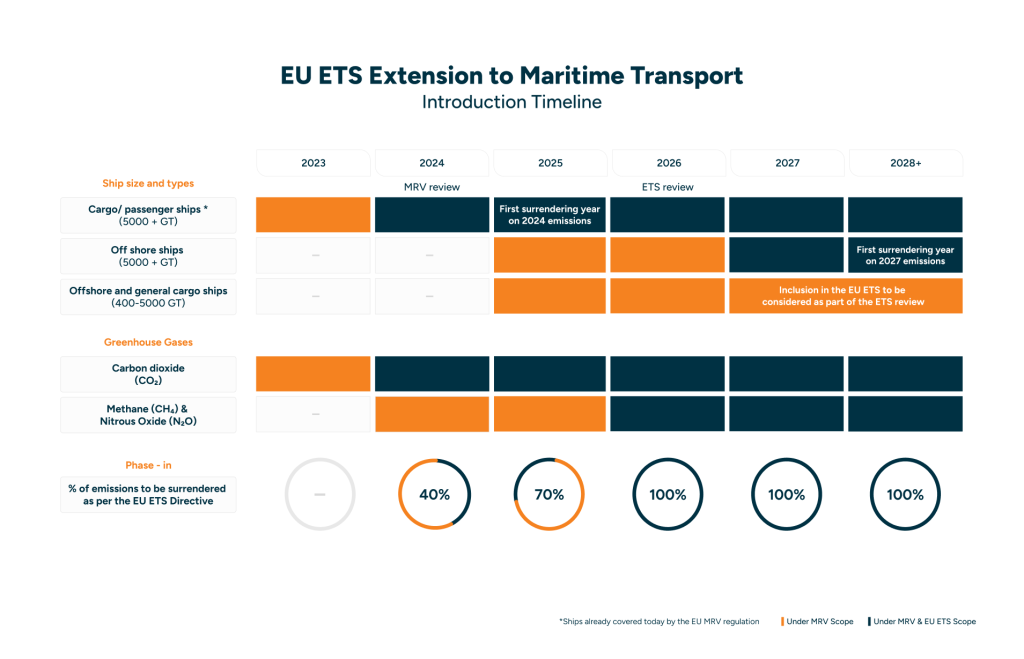
The EU Emissions Trading System has been extended to cover maritime transport to and from EU ports. As of 2025, shipping companies are required to surrender allowances in respect of carbon dioxide emissions from in-scope activities; from 2026, emissions for methane and nitrous oxide will also be covered by the surrender obligation.
Administering Authority
A shipping company with maritime transport activities that are in the scope of the EU ETS will be attributed to an “administering authority in respect of a shipping company” thus:
- for a shipping company registered is a Member State, then that Member State will be the administering authority;
- for a shipping company that is not registered in a Member State, Member State acting as the administering authority is attributed on the basis of the greatest estimated number of port calls from voyages performed in the last four monitoring years;
- for a shipping company that is not registered in a Member State and that did not perform any voyage falling within scope in the preceding four monitoring years, that company is attributed for the first time to the Member State where a ship of your company has arrived at or started its first voyage falling within the scope of the EU ETS.
Monitoring and Reporting
Shipping companies must:
- Monitor Emissions: Track emissions and other relevant parameters.
- Report Data: Submit aggregated emissions data at the company level to the national Competent Authority.
The rules relating to monitoring and reporting of emissions, for the purposes of subsequent determination of surrender obligations under the EU ETS Directive, are established by Regulation (EU) 2015/757.
Implementation Milestones
More details coming soon
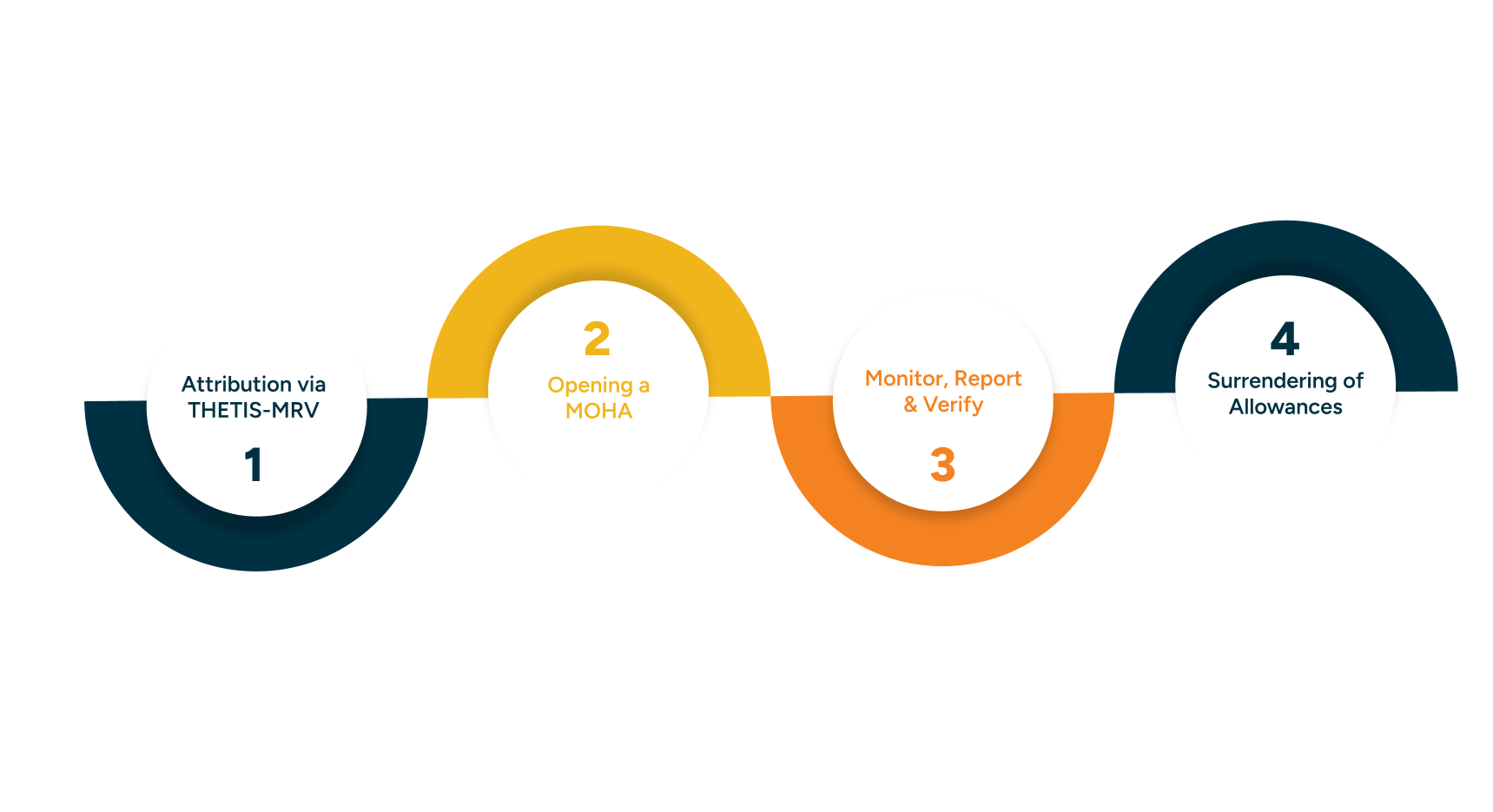
Attribution via THETIS-MRV
A shipping company remains assigned to the Member State according to the Commission’s list, until those variations are reflected in an updated list. The list is updated every two years (or every four years for non-EEA companies attributed to a Member State based on their ports of call in the last four monitoring years).
For new shipping companies that are not included in the attribution list but perform voyages covered by the EU ETS Directive, the rules set out in Article 3gf of the ETS Directive apply. Based on these rules, companies should identify their Administering Authority through the THETIS-MRV platform.
- Operated by EMSA, the THETIS-MRV helpdesk will assign you to an AA in the system.
- The helpdesk can be contacted through the following email address: [email protected].
- Once associated with an Administering Authority, the company will then be added to the next update of the attribution list.
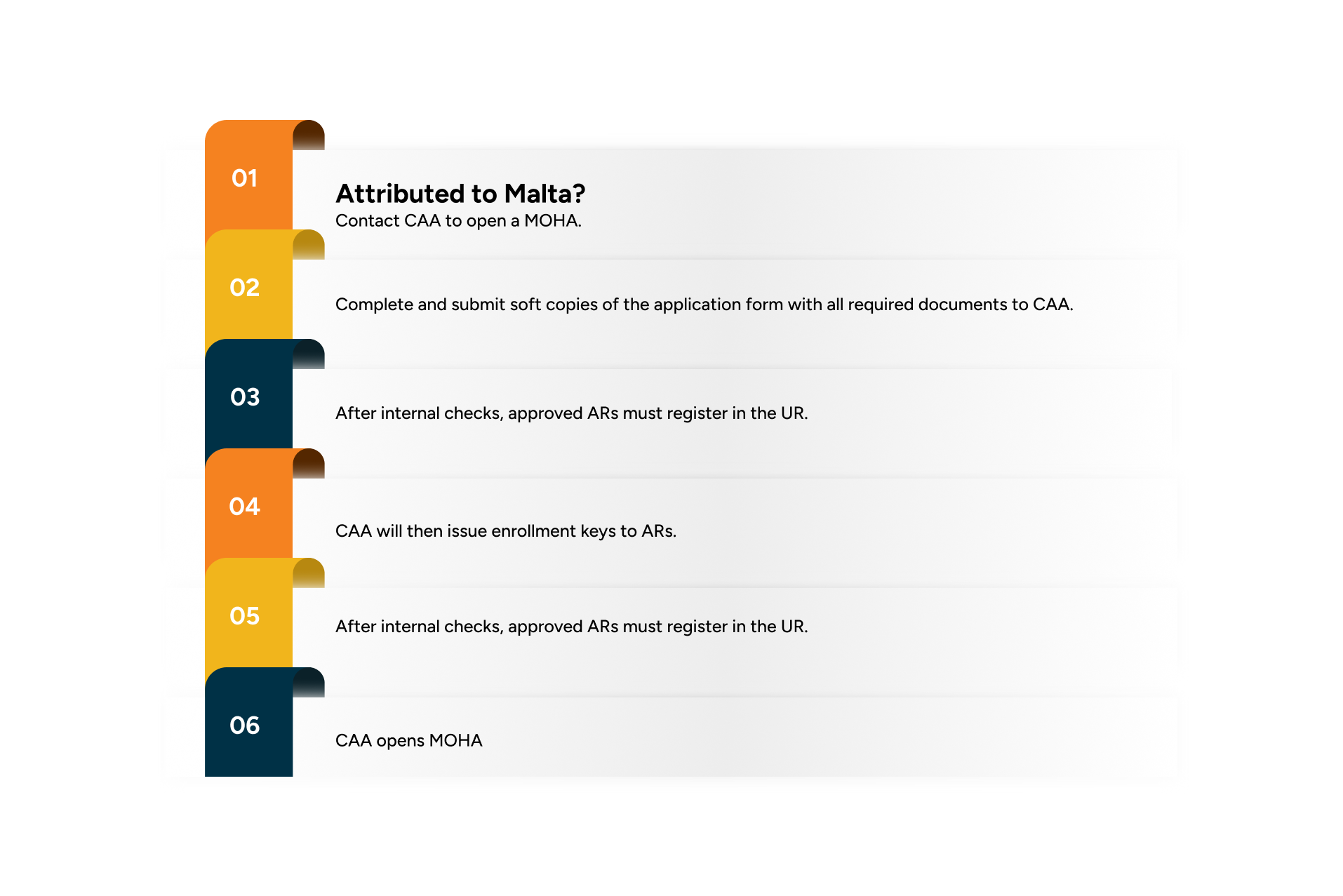
Opening a Maritime Operator Holding Account (MOHA)
More details coming soon
ETS Maritime Compliance Cycle
When? | What? |
Without undue delay | Revise and submit the updated monitoring plan (MP) for each ship to the verifier |
From January 1, 2024 | Start monitoring emissions of CO2, CH4 and N2O. |
By April 1, 2024 (or within 3 months of first EEA port call) | Submit an approved monitoring plan to the administering authority |
By December 31, 2024 | End of monitoring period. Prepare and send the annual emission report to the verifier. |
By March 31, 2025 (and annually) | Submit verified annual emissions reports to the administering authority, flag state authorities, and the European Commission. Submit verified aggregated emissions data at company level to the administering authority |
By September 30, 2025 (and annually) | Surrender EU ETS allowances corresponding to verified annual emissions |
Within 3 months of changing shipping company | Submit a verified partial emission report to the new shipping company and relevant authorities. |
Source: The European Commission
Surrendering of Allowances
Shipping companies must purchase and surrender emission allowances for 50% of their emissions from voyages that start or end outside the EU and 100% of emissions between EU ports.
In reference to reported emissions from the previous year, shipping companies are required to surrender the following number of allowances:
- 2025 = 40%
- 2026 = 70%
- 2027 onwards = 100%
From 2026, shipping companies will also need to account for methane (CH4) and nitrous oxide (N2O) emissions.
From 2027, offshore ships of or above 5000 GT will also fall under the scope of EU-ETS Maritime Transport.
Consequences of non-compliance
Compliance is crucial for shipping companies operating within the European Economic Area (EEA). All allowances must be surrendered by September 30th of each reporting period. Non-compliance with EU-ETS regulations in the maritime sector can lead to several significant consequences:
- Financial Penalties: Shipping companies that fail to surrender the required number of emissions allowances (EUAs) will face substantial fines. As of 2024, the penalty for each tonne of CO2 emitted without the corresponding allowances is €100, adjusted annually for inflation. This is in addition to the obligation to surrender the missing allowances in the following year.
- Detention of Ships: Persistent non-compliance of two or more consecutive reporting periods can lead to more severe measures, including the detention of ships at EU ports until the shipping company fulfils its surrender obligations.
- Revocation of Permits: In extreme cases, non-compliance might lead to the revocation of operating permits within the EU, effectively barring a shipping company from operating in European waters.
Overall, the consequences of non-compliance with the EU-ETS Maritime regulations are designed to ensure that shipping companies take their environmental responsibilities seriously and contribute to the EU’s overall goal of reducing greenhouse gas emissions.
Useful links
The European Commission:
An audiovisual explanation of the EU-ETS – Video Link
Main EU Maritime Transport legislations:
- ETS Directive 2003/87/EC (consolidated text)
- MRV Regulation (EU) 2015/757 (consolidated text)
- Legal Notice under the Climate Action Act, Cap 643 LN 316-2024
Latest information on the EU ETS for the maritime operators:
- Reducing emissions from the shipping sector – European Commission
- FAQ – Maritime transport in EU Emissions Trading System (ETS) – European Commission
- FAQ – Monitoring, reporting and verification of maritime transport emissions – European Commission
Administering Authority for EU-ETS in Malta – Climate Action Authority
Email: [email protected]
Phone: +356 23850500
Website: https://www.climateaction.gov.mt/
European Maritime Safety Agency (EMSA) THETIS-MRV
Website: https://mrv.emsa.europa.eu/#public/eumrv
Email: [email protected]

